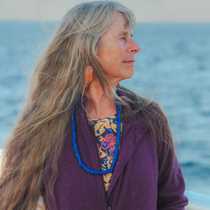

In the Gulf of California, searching for marine mammals. Evening at Isla Danzante; activities and dinner barbecue ashore.
The National Geographic Sea Bird left her protected anchorage off the west side of Isla Santa Catalina, early this morning, heading north into the Gulf of California. Slight pink and yellow rays filtered through delicate clouds as the rising sun peeked over the horizon to the east. We continued cruising, in searching for several species of marine mammals that are known to inhabit these waters. Why are these waters so productive, and why are so many marine mammals found for those who take the time for some serious searching? The rugged mountains we see along the eastern side of the Baja peninsula reflect a complex and extremely rugged sea floor; and, a sea floor that can be thousands of feet deep! During many of the months of the year, ocean currents bring nutrients up from the depths of the Gulf to the sunlight at the surface. The mix of nutrients, light, phytoplankton feeding and on up the food change brings about a process called primary productivity, which is the foundation of all marine life. Looking over the bow, in places the water looked like soup! The presence of this much food will ultimately bring large and small predators.
This morning, we were very lucky aboard the National Geographic Sea Bird, as in every direction as a pair of binocular searched, we could find yet another blow from a marine mammal. Blue whales, Fin whales, a possible Bryde’s whale, Humpback whales, Bottlenose dolphins and the most fun and exciting, were two sightings of Short-finned Pilot whales! The first group passed us by and made a customary deep dive eluding every spotter on the bow and around the ship. Then an hour later another group were spotted at quite a long distance from the ship. As we approached this second group of Pilot whales they turned and decided that we just might be interesting. In the customary “chorus line” that Pilot whales can be seen traveling in, several large males, females and smaller animals passed by very close to the bow of our ship again and again! One smaller animal lifted its bulbous head just below the eye as if to take a look at the many faces hanging over the bow watching and listening to the exhalation and intake of air. The mixture of extremely calm conditions, clouds reflected in water patterns and the sound of at least twenty Pilot whales moving through the water only exemplified the richness of this unique body of water. If we were not spell bound enough, as the Sea Bird remained still the Pilot whales passed in just the right position for the slight breeze to carry the smell of the breath of this particular group of Pilot whales past the bow, covering us with an invisible cloud of the smell of fish!
A morning-spent whale watching had been fruitful with every sense touched in some way. As the National Geographic Sea Bird pulled away from the second group of Pilot whales, making her way towards our afternoon destination, a fellow guest approached the bow with a delicate hitchhiker riding on her hand, a Monarch butterfly had taken up residence calling the hand of one of our younger guests its temporary home.
Directly after lunch the Sea Bird pulled into Honeymoon Cove located on Isla Danzante and preparations were made for snorkeling, kayaking and hiking. This small mountainous island, located very near the Baja peninsula gives a visual story of the geologic growth of the Baja peninsula. In every direction we could see extremely ragged volcanic rock formations….all part of the Sierra de la Giganta to the west or the close by islands, like Isla Danzante, which visually show the violent geologic history that formed this beautiful landscape. Hiking up to two lookouts gave a wide view of the surrounding area, while kayaking and snorkeling gave closer views of the landscape from the waters edges. As the sun dipped towards sunset over the mountains of the Baja peninsula, the hotel staff from the Sea Bird brought all necessary supplies to a neighboring beach for an evening barbecue. Around a beach fire we celebrated the coming together of several cultures in the customary art of sharing food, story telling, and song.